



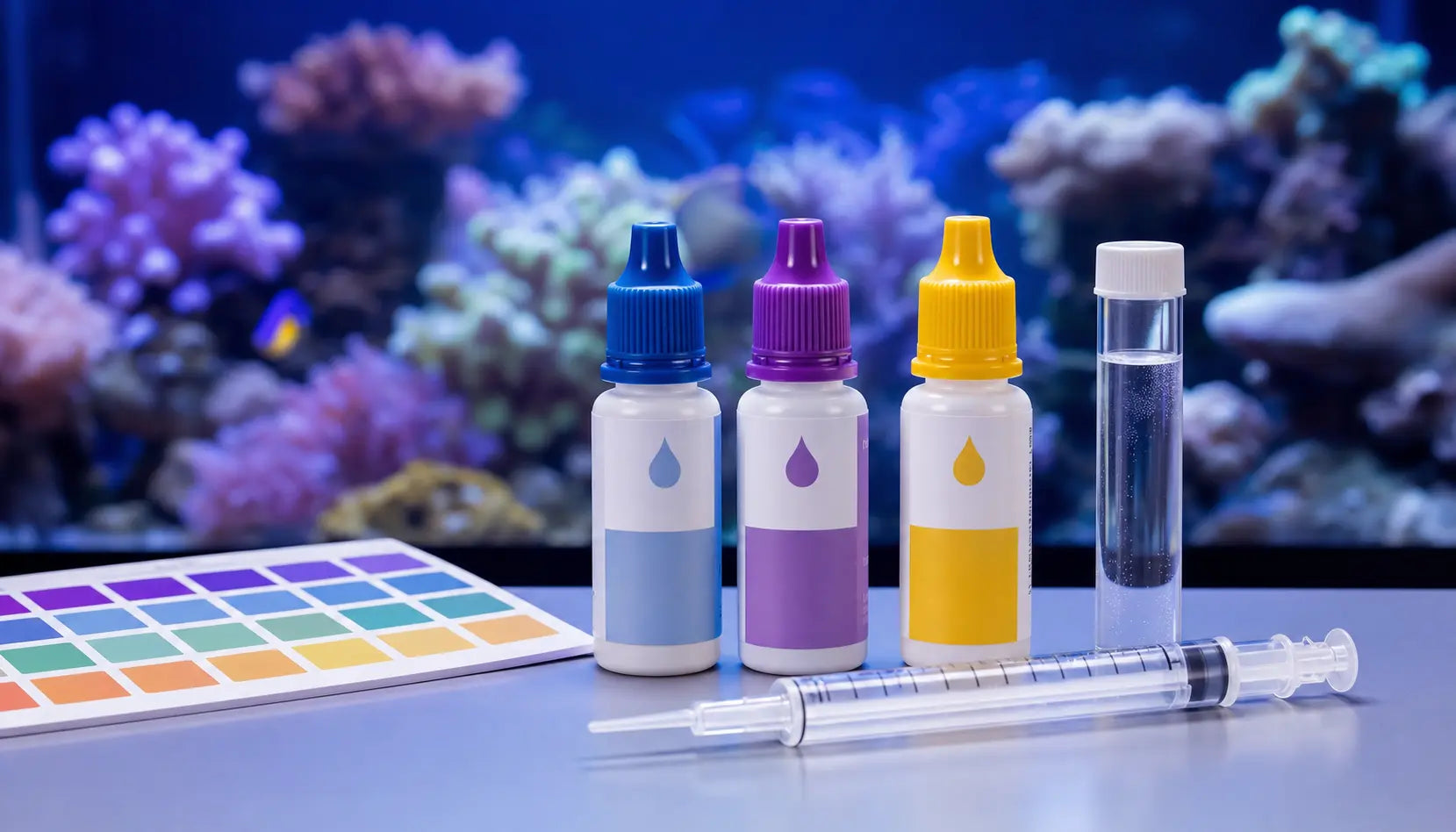
If you keep stony corals, three numbers matter more than almost anything else in your tank: calcium, alkalinity, and magnesium. Reef keepers often call them “the Big 3” because every SPS and LPS coral, every bit of coralline algae, and most of your invertebrates depend on a steady supply of these three elements to build their skeletons. Get them right and your reef grows, colors up, and stays stable for years. Get them wrong — even slightly — and you’ll spend your hobby chasing stalled growth, bleached tips, and mysterious coral deaths that always seem to trace back to water chemistry.
The good news is that the fix isn’t complicated. It starts with accurate testing. This guide breaks down what calcium, alkalinity, and magnesium actually do in a reef tank, why testing them regularly is non-negotiable, and how the Waterbox Test Kits make that process fast, precise, and easy to stick with.
What Calcium, Alkalinity & Magnesium Actually Do
Calcium: The Building Block
Calcium (Ca) is the raw material corals use to build calcium carbonate skeletons. Every time a coral calcifies, it pulls calcium ions out of the water — along with carbonate supplied by alkalinity — to grow. Keep calcium in the recommended 420–460 ppm range and you’ll see consistent skeletal growth, thicker coralline algae coverage, and healthier clams and other calcifying invertebrates. Let it slide and growth stalls, skeletons weaken, and coralline algae stops spreading.
Alkalinity: The Stabilizer
Alkalinity (measured in dKH) is the buffering capacity of your water — it stabilizes pH and, together with calcium, forms the carbonate foundation corals need to build strong skeletons. Most reef keepers target 7.5–9.5 dKH. Alkalinity is also the parameter that swings the fastest and hits corals the hardest when it’s unstable — sudden drops or spikes are one of the most common causes of coral stress and tissue recession.
Magnesium: The Silent Partner
Magnesium doesn’t get consumed nearly as fast as calcium or alkalinity, which is exactly why it gets overlooked — and why that’s a mistake. Without adequate magnesium (target 1,200–1,400 ppm), calcium and alkalinity can bind together and precipitate out of solution as unusable “snow,” making it nearly impossible to keep either one stable. Magnesium is the reason you can run higher, more coral-friendly calcium and alkalinity levels without everything crashing out.
Why You Can’t Skip Regular Testing
Here’s the part that trips up a lot of reef keepers: dosing without testing is just guessing. Corals consume calcium, alkalinity, and magnesium continuously as they grow, and that consumption rate changes as your tank matures, as you add new coral, and as lighting or feeding shifts. The only way to know how much to dose is to test consistently and track the trend over time.
A simple, proven approach used across the hobby:
- Establish a baseline. Test all three parameters before you dose anything.
- Wait two to three days without dosing, then test again. The difference tells you your daily consumption rate.
- Dose to replace what was used, not what you think should be needed.
- Retest every 2–3 days while you’re dialing in a new tank, then stretch out to weekly or biweekly once levels hold steady.
This is the exact rhythm behind the Waterbox Method, and it only works if your test results are accurate. Inaccurate readings lead to overdosing, underdosing, and the kind of parameter swings that stress even hardy corals — let alone sensitive SPS.
The Benefits of Waterbox Test Kits
Waterbox built its titration-based test kits specifically to solve the accuracy problem, validating results against ICP standards so hobbyists can trust the numbers they’re dosing against. A few reasons they stand out:
- Purpose-built accuracy. Each kit is calibrated to the exact ranges that matter for reef keeping — Alkalinity Test Kit for the 7.5–9.5 dKH range, Calcium Test Kit for 420–460 ppm, and Magnesium Test Kit for 1,200–1,400 ppm — so you’re not trying to read a general-purpose kit against reef-specific targets.
- Long-lasting value. The Alkalinity kit delivers roughly 80–100 tests, while the Calcium and Magnesium kits each provide 55–65 tests, meaning weekly testing routines can run for the better part of a year on a single kit.
- Simple, repeatable titration method. Titration testing gives a sharper, more precise endpoint than many drop-count or colorimeter kits, which matters when you’re trying to catch small week-to-week trends rather than big obvious problems.
- Built to pair with dosing. Every kit is designed to work directly with the Waterbox Method and the Reef Dosing Calculators — test your levels, plug the numbers into the calculator along with your tank volume, and get an exact dosing amount instead of guessing.
- Better together. If you’re setting up a new tank or replacing old, expired reagents, the Reef Test Kit Starter Bundle covers all three parameters at once, so you’re never testing calcium without the alkalinity and magnesium context that explains what’s actually happening in your water.
Turning Test Results Into Action
Testing only pays off if you act on the numbers. Once you know your baseline and daily consumption for each parameter, the Core Elements Pack (Calcium, Alkalinity, Magnesium) gives you matched liquid supplements to replace exactly what your reef is using — no more mixing and matching random dosing solutions with unclear concentrations. Run your test result through the Reef Dosing Calculator, dose the recommended amount, and retest in a few days to confirm you’re holding steady.
A quick rule of thumb worth remembering: don’t chase a specific number, chase stability. A tank running a slightly “imperfect” but rock-steady 7.8 dKH will almost always outperform one that bounces between 7.5 and 9.5 every week.
The Bottom Line
Calcium, alkalinity, and magnesium are the three parameters that most directly determine whether your corals thrive or struggle. Testing them accurately — and on a consistent schedule — is what separates a reef tank that runs itself from one that’s a constant guessing game. The Waterbox Test Kits give you the accuracy to trust your numbers, and when paired with the Core Elements supplements and Reef Dosing Calculator, you have a complete, repeatable system for keeping your reef chemistry exactly where it needs to be.
Ready to dial in your reef chemistry? Shop the Waterbox Saltwater Test Kits and start testing with confidence.

Share:
How to Design Your Own Aquarium: Step-by-Step Guide for 2026